

There are many myths & prejudices surrounding people who inject or use drugs
Who we serve
There are many myths and prejudices surrounding people who inject or use drugs.
The stereotypical vision is limited, incorrect and harmful & often assumes addiction and involvement in crime.
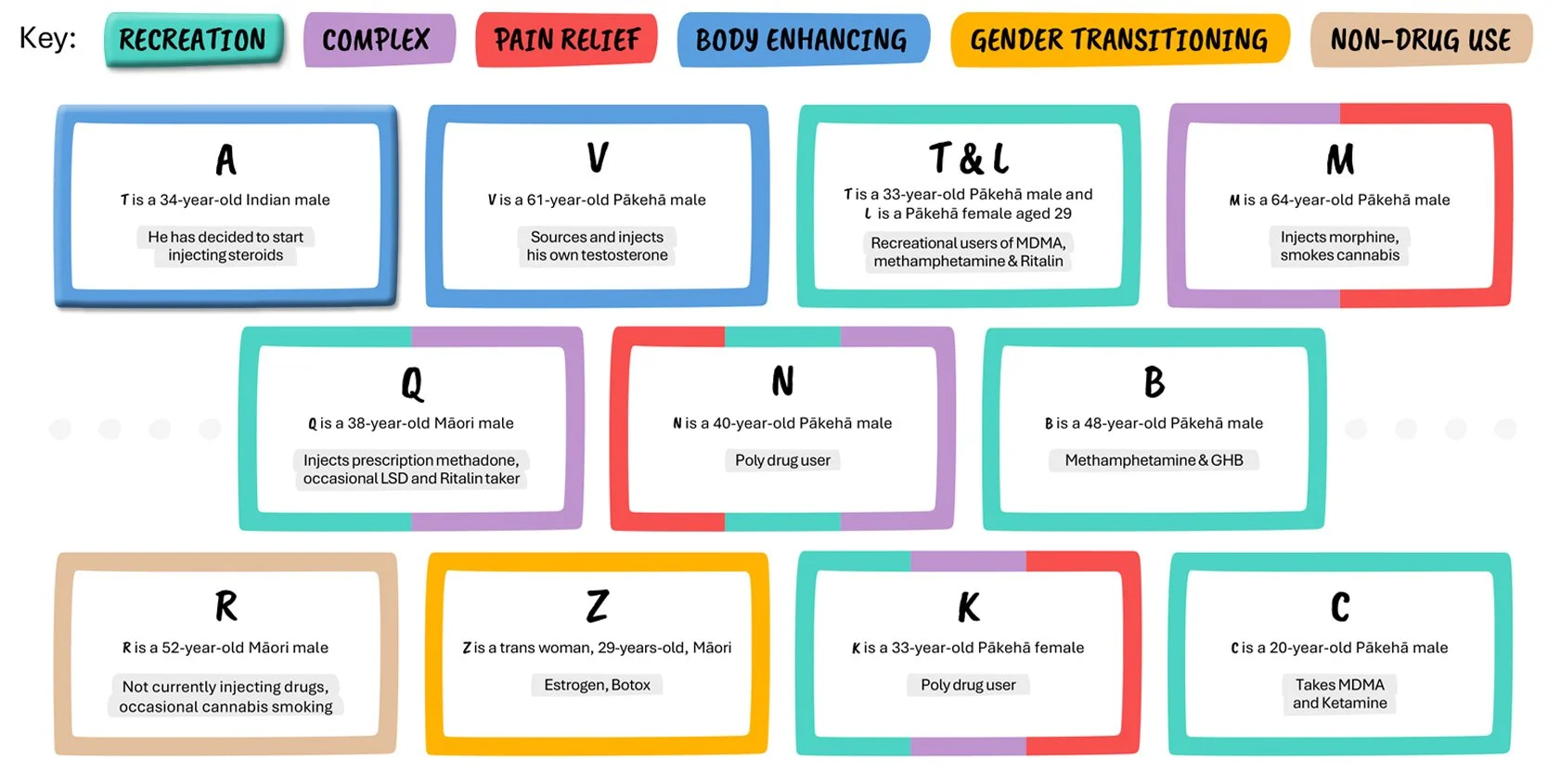
At DISC we have created whaiora personas in hope to bust some myths, introduce people to our clients and cultivate understanding for the world we work in. Personas are fictionalised characters but based on a mix of real experiences and features. They are based on aspects of real people; their stories, their journeys, their needs.
Personas are tools for storytelling and expressing characteristics of a client group. They are meant to resonate, but not be perfectly representative of every person – that just isn’t feasible. They are combinations of client characteristics, put together in a way to help people understand what the clients are like and what they are experiencing.
People use drugs or come to us for…
-
-
Being dependent on one or more drugs
Could be daily or weekly drug use
Could also be injecting methadone
Reasons for pathways into dependencies are complex
Often with treated/untreated mental health conditions
Complex situations such as homelessness, incarceration, disconnected from support
Trauma(s)
♡ MEET OUR WHAIROA PERSONAS ♡
M’s story | Q’s story | N’s story | K’s STORY -
-
-
Hormones purchased online due to lack of availability via mainstream medical system or wanting to choose their own dose or type of hormone
♡ MEET OUR WHAIROA PERSONA ♡
V’s story -
Friends and family coming in for advice or Naloxone
People engaging in needle play/medical play
Ex-drug takers injecting saline just for the ritual aspect
♡ MEET OUR WHAIROA PERSONAS ♡
R’s story
Meet our whaiora personas….
A’s story
A is a 34-year-old Indian male
Owns a home in Ōtautahi Christchurch
He has decided to start injecting steroids
Body Enhancing
A is married with three young children and he owns and runs a successful small business. He plays Kabaddi with his friends, and he recently joined a gym to get stronger and bulk up. Some guys he spoke with at the gym said steroids make them feel great and they gain muscle easier; but A doesn’t want to just buy steroids from them – he doesn’t know them that well.
But after doing his own research, A eventually decided to try steroids – he really likes the idea of looking more muscular. He’s not going to tell his wife and he’s worried about compromising his health and maybe hurting his business reputation if people find out. He’s not keen to talk to his family GP either.
Being safe is of the utmost importance to him. He found out about the local harm reduction service while doing online research about steroid injecting. He doesn’t like the idea of being a “drug user” or having to use a harm reduction service to get what he needs, but he’s also conscious of keeping himself safe while he experiments with steroids.
-
Frank and non-judgmental advice
A professional, knowledgeable, discreet advocate who can safely guide him through his decisions
Stigma-free support and a place to speak freely about what he’s doing
He’ll need new equipment, including wheel filters, when the time comes
Trusted healthcare staff to turn to if things go wrong
Access to blood testing to monitor how steroids affect his body
The offer of hep C screening
V’s story
V is a 61-year-old Pākehā male
Owns a home in Fendalton
Sources and injects his own testosterone
Body Enhancing
V has been married to his wife for 35 years. He has four children ranging in ages from 19 to 32. He is the long-standing CEO of a local commercial enterprise.
About nine years ago he had some blood tests and discovered he had low testosterone levels. His GP didn’t feel they were low enough to be put on a testosterone script. V was talking to a friend at the gym about how he was feeling about all that, and his friend said he could fix this by buying testosterone on the black market and injecting himself.
So, for nine years now he’s been sourcing his own testosterone and injecting himself. Lately he said he feels 35 years old again. On his last visit to get needles, he was offered a free hep C screening and found out that he was negative and has never had it. He was reassured by that news.
-
Frank and non-judgmental advice
Clean injecting equipment and a place to safely dispose
Maintaining his confidentiality
Informing him that he can see the harm reduction nurses if he needs to
Making things discreet and easy
Hep C screening and treatment
Provision of a steroid clinic
T&L’s story
T is a 33-year-old Pākehā male, L is a Pākehā female aged 29
Homeowners in Motueka
Recreational cannabis, MDMA, morphine, methamphetamine and Ritalin
Recreation
T & L met when they were young, and they were into a partying and experimental scene. Both T & L have always been curious about drugs and over time, they have tried just about everything.
They have two young children. They are homeowners, and they own and operate a small renovations company. T is a builder and L is studying part time to become a social worker while also doing office work for their business.
They are really busy – they get breaks during the school holidays when the kids go to L’s parent’s farm. T & L take that time to party with their friends, but they know they need to be careful. They sometimes drive to Christchurch to have their drugs checked – they initially learned about drug checking at a festival and they really wish they could have their drugs checked locally when they need it.
They don’t inject anymore but they do their best to clean the pipes they use with their friends. Last time they went to the harm reduction service for drug checking, they got hep C screening because one of their friends tested positive for it, and they learned from the harm reduction nurse that you can pass it via pipes and snorting straws.
-
Giving them assurance that they know the content of their drugs
A local drug checking service could mean they do this more regularly
Free, frank and confidential advice
Safer smoking and snorting kits*
Advice about safe drug combinations
Hep C screening and treatment
*Not currently allowed to provide this
M’s story
M is a 64-year-old Pākehā male
Lives in social housing in Mosgiel
Injects morphine, smokes cannabis
Complex | Pain relief
M is currently unemployed and hasn’t been able to work due to his chronic pain and serious depression. He has no children and has a stable, supportive relationship with his partner.
He has no children and has a stable, supportive relationship with his partner. He began using morphine just over 10 years ago after struggling with ineffective prescription medications. He was in a bad car crash in his early 30s and the pain built up over time, becoming worse with age. His GP and specialists told him he was on the right medication, but it never really helped his pain and the physiotherapy they prescribed just made it worse. As time went on, he developed worsening anxiety and depression. He lost his job because he couldn’t get out of bed some days.
To help, his mate injected him from some of his own morphine supply and equipment, which immediately put him out of his pain. So, he continued to source it illegally through him. He also smoked cannabis to cope and relax. After being offered a hep C screening by a peer worker he discovered he was positive. At first, he declined to take the treatment because he was worried about the medication, but he learned from the nurse that the new treatment has a high cure rate with lower side effects. The treatment actually made him feel so much better; he hadn’t realised how fatigued he was.
He would like to cut down and get on an opioid substitute so he can have a legal script and hopefully adequate pain relief. But he now has a serious distrust of doctors and the healthcare system after being refused opioids, despite explaining it was the only thing that worked for his pain. He knows that he’s been labelled a drug seeker, so he feels he doesn’t get taken seriously when he’s asked for help.
-
New needles and other equipment
Advice to keep injecting sites healthy and free of infections
A place to dispose of equipment
Opioid substitution treatment
Proper pain management
Access to health professionals that understand and don’t judge
Mental health support for depression and anxiety
Naloxone kit
Hep C screening and treatment
Advocacy and peer support
Q’s story
Q is a 38-year-old Māori male
Rents a house in Ōtautahi Christchurch
Injects prescription methadone, occasional LSD and Ritalin taker
Recreation | Complex
Q is a busy self-employed electrician. He has a partner and one child. He and his partner are both on prescribed methadone. They sometimes take LSD or Ritalin at parties, if it’s going around their friend group – he sometimes gets it checked before taking it because he learned he can do that at our harm reduction service.
Q goes to the chemist three days a week to take his methadone on site and pick up takeaway doses. When he takes the methadone home, he injects it because he prefers taking it this way. For safety, he was given Naloxone kits.
He gets injecting infections and has various troubles with his veins – he never goes to his GP or the hospital but goes to get treatment from the nurses at our harm reduction services. Because he injects on his pick-up day, he goes without a methadone dose the following day. This causes minor withdrawals, and he feels a bit run down on those days in between.
Those ups and downs really wear on Q, but he’s not sure what to do. He can’t be honest with the opioid substitute clinic – they believe he’s a “model” client and he doesn’t want to risk not getting his prescription. He wishes he could be straight up with them, but he feels it’s safer to hide his injecting. Being prescribed methadone keeps Q away from using morphine, and takeaway doses are vital so Q’s work isn’t further disrupted by having to make even more trips to the chemist.
-
Offering a place of discretion and support where he can be honest about what he’s doing with peers
Professional, supportive advice
Empathy/lack of judgement
An advocate or peer support
New needles, syringes and disposing equipment
Checking services for his recreational drugs
Advice about drug combining
Naloxone
Hep C screening and treatment
Healthcare and advice for skin and veins
Injectable opioid prescribing*
* This is not currently available in NZ
N’s story
N is a 40-year-old Pākehā male
Lives on the streets N’s story in Ōtepoti Dunedin
Poly drug user
Pain relief | Recreation | Complex
N is in a position where he’s just trying to survive. He’s had a very hard life, having fled an abusive home as a young teen and then ended up in prison in his early 20s. He’s disconnected from family and friends, which he’s upset by sometimes, but he also feels judged by them so he’s avoiding contact for now.
N often feels lonely and angry and likes to dull this feeling with drugs. He’s dealt with a lot of trauma but he’s never received mental health support. He also isn’t getting any income or other benefit support. Work and Income keep trying to send him for job training, which he can’t do right now, given his lack of stable living conditions and ongoing mental health challenges and unaddressed trauma.
Because N is so vulnerable, he gets taken advantage of by others on the streets. He tries lots of drugs – just trusting whatever is going around and hoping it gives him a break from his negative feelings. He gets a lot of bad skin infections and feels unwell a lot of the time. He has seen the doctor at the local harm reduction service, plus he took a hep C test and it came up positive. He was upset by this but was grateful that he could get the treatment for free.
He comes into the service because it’s the only place he doesn’t feel judged. He’s slowly building a relationship with the harm reduction peer workers and they’re glad he pops in for a cuppa and a chat so they can help him into a safer situation over time.
-
Getting him on income support
Adequate, stable housing
Sexual health products
Drug checking
Hep C screening and treatment
New needles
Referrals to other support services
Mental health treatment referrals
Protection from being taken advantage of through enhanced connections
Access to food
B’s story
B is a 48-year-old Pākehā male
Splits time between Ōtautahi Christchurch & Tāmaki Makaurau Auckland
Methamphetamine & GHB
Recreation
B is a successful, wealthy lawyer. He’s married to a woman, has two teenage sons and he has sex with men. His wife has some knowledge of his sex life outside the marriage, but they pretty much agree not to talk too much about it – this works for them. She has no knowledge of his drug use.
When B is away on business trips to Christchurch, he hosts Chemsex parties (injecting methamphetamine, taking GHB orally) at their apartment. He sometimes uses condoms, but lately he’s been taking “PrEP” before and after these weekends to prevent HIV.
B wouldn’t dare go to the needle exchange in Auckland where his family lives – he doesn’t even want to use the afterhours dispensing machine for fear of someone seeing him. Instead, he waits until he’s in Christchurch and uses the dispensing machine there – even then, he always goes early in the morning to avoid seeing anyone. He also occasionally gets needles posted to his apartment from the online service. When he needs sexual health advice he goes to a clinic in Christchurch – he keeps his life there as separate as possible, and he thinks he’s got his methamphetamine use under control.
-
Discretion so he feels safe and doesn’t skip on using new needles
HIV, hep C and STI screening and treatment
Sexual health products
Drug checking
Information about safe drug combining
A reliable afterhours dispensing machine and/or ways to purchase online
Access to PrEP
Advice from peers in the men who have sex with men community
Make sure he doesn’t feel too stigmatised so he continues to be as safe as he can be
R’s story
R is a 52-year-old Māori male
Lives with family in Rangiora
Not currently injecting drugs, occasional cannabis smoking
Non-drug use
R is doing well now but has had a difficult past. He’s been in and out of prison and his past drug use was mainly methamphetamine and morphine. He had a short stint on methadone but managed to wean himself off because he didn’t like how it felt, and he didn’t like having to show up to the OST clinic. The withdrawals were awful, but he managed to do it.
He’s currently on the benefit and living with his niece and her husband. He would love to have a job, but his criminal convictions are getting in the way. His niece offered to pay to get his teeth fixed, but he was refused treatment by one dentist because he ticked the box that he’s had hep C in the past, even though he took the medication and he doesn’t have an active infection. This has put R off the idea of going to another dentist – he just doesn’t want the judgement.
R’s friends are drug users, and despite his history, he manages to be around them. He drinks alcohol and smokes cannabis but draws the line at other drugs now. At a recent party, he ended up using a Naloxone kit on a guy who overdosed – this really scared R but also made him feel like he had a role to play in helping others. He also looks after his friends by taking their drugs into the drug checking service to get them checked. He enjoys the sense of belonging at the service and he likes to feel included in something.
-
Providing access to Naloxone
Hep C screening and treatment
Helping him get into a job or purposeful activity or volunteer/peer supporter roles
Advocating for him at the dental clinic
Ensuring he can get his friends’ drugs checked when needed
Encouragement and support for his decision to stop using drugs
Opportunities to use his lived experience to support others
Z’s story
Z is a trans woman, 29-years-old, Māori
Lives in Waihōpai Invercargill
Estrogen, Botox
Gender transitioning
A few months ago, Z moved to Invercargill from Oamaru to start a new life. Z was assigned male at birth but identifies as female and has been seeking help to feminise her appearance. The move to Invercargill has been positive, and the rainbow community there has been supportive.
Z works in retail and lives with friends. She has a GP and a counsellor. Z’s GP has been prescribing estrogen, but she recently found out from friends and online research that injectable estrogen is much stronger and works faster. She is also able to get Botox online – both drugs need cryptocurrency for purchasing. It’s sometimes hard for her to know if she’s on reputable websites, but she’s managed to get the drugs delivered. She has been worried about whether the online estrogen is real or not, but she’s willing to risk it.
Her GP isn’t happy about this and is worried she’s going to get too much estrogen, but Z is happier with the results of the injectables. Z hasn’t told the GP about the Botox. She definitely won’t ever share needles and understands the importance of getting new equipment.
-
New needles, syringes and safe disposal equipment
Providing non-judgmental advice and support
Encouragement to stay connected with GP
Well researched information about safe online estrogen sources and Botox supplies
Regular access to a drug checking service
K’s story
K is a 33-year-old Pākehā female
Lives in Te-K’s story Tihi-o-Maru Timaru
Poly drug user
Recreation | Complex | Pain relief
K lives with her 10-year-old son in a friend’s house. She’s moved several times to avoid a violent and controlling ex-partner, but she’s fairly settled now, and her son likes his school. Prior to that they had been living in hotels and shifting a lot. They’ve both been deeply traumatised by the violence and the need to keep moving. She’s disconnected from her mother who also has addiction issues. She’s been supported by Women’s Refuge in the past, but she hasn’t had other mental health support for her trauma.
K has been a sex worker for most of the past decade. She’s had other jobs, but this one pays much better. She started using methamphetamine occasionally when her clients suggested it – but then she liked how it felt because it helped her get through the long nights. She now injects daily. Some of her clients insist on injecting her, so she always keeps a supply of new needles around for that purpose. She is currently working with our harm reduction service for hep C treatment and wound care when she gets infections.
-
A good supply of new injecting equipment
Safe needle and equipment disposal
Advice on keeping injecting sites clean and healthy
STI and hep C screening and treatment
Sexual health products
Drug checking, testing strips
Stable housing for her and her son
Referral to mental health support and Women’s Refuge support
Connection to the NZ Prostitute’s Collective
C’s story
C is a 20-year-old Pākehā male
Flatting in Ōtepoti Dunedin
Takes MDMA and Ketamine
Recreation
C is a university student and loves going to festivals whenever he can. He’s very new to drugs, but he and his friend group are starting to experiment with MDMA and Ketamine, usually at festivals. The last time they were at a festival, the queue to get their drugs checked was really long, so they didn’t bother doing it. He also felt a bit self-conscious waiting in the queue for drug checking – there were people there that could see him, and he was worried it could get back to his family via his sister’s friends.
Recently C heard that he could go into our harm reduction service and have his drugs checked – this was appealing because it was more private. So, he and his mate went into the service for checking and they were also offered information about drugs they shouldn’t mix. They were given some fact sheets about MDMA and Ketamine by the peer worker – there was a lot of information in there that C didn’t know about. They also learned about DISC facebook page where they could get information about some harmful drugs that might be circulating at upcoming festivals.
-
Drug checking before festivals
Providing advice about mixing different drugs and safer drug use
Keeping him up to date about harmful substances circulating in the community
Discrete and knowledgeable place to go for unbiased information about drugs